The Cybersyn operations room
A scroll-driven walkthrough of the Project Cybersyn operations room in Santiago, 1972: the seven chairs, the wall screens, the telex network behind them and the Cyberfolk meter, ending with the coup of 11 September 1973.
proyecto synco · santiago · 1972
sala de operaciones
Santiago, 1972
Stafford Beer and Allende's government built a room to steer a newly nationalised economy. Gui Bonsiepe's team designed it.Seven chairs
Fibreglass swivel chairs with buttons in the armrests to switch the screens. No keyboards: Beer didn't want to "insinuate a girl between themselves and the machinery".The screens
The walls showed the economy as flows, levels and alarms, in a visual language of their own.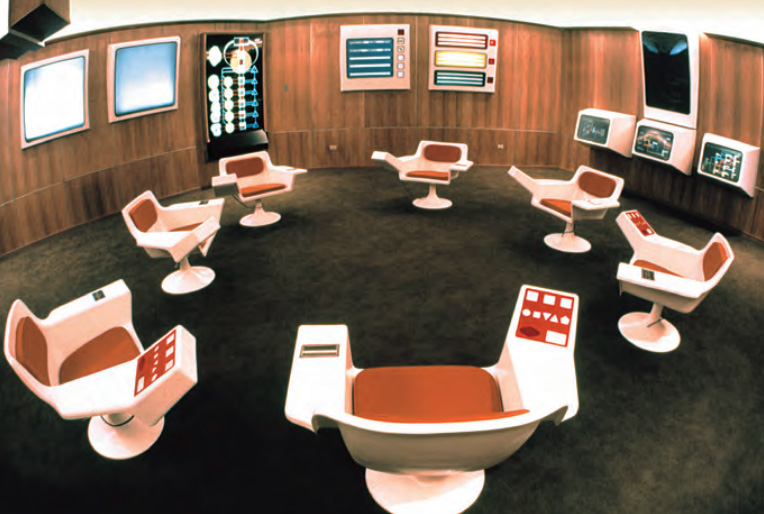
The operations room, Santiago, 1973. Photo: Rodrigo Walker, courtesy Gui Bonsiepe. Reproduced for criticism and review. Behind the screens
They showed prepared slides. The room looked more omniscient than its data ever was.Cybernet
The part that worked was humbler: a telex network linking factories to Santiago.Cyberfolk
A plan to let citizens signal their satisfaction as it happened. Beer's son built prototype meters from radio parts and pink and green cardboard. They never saw service.11 September 1973
The air force bombed the presidential palace. Allende died inside, and the project ended with him.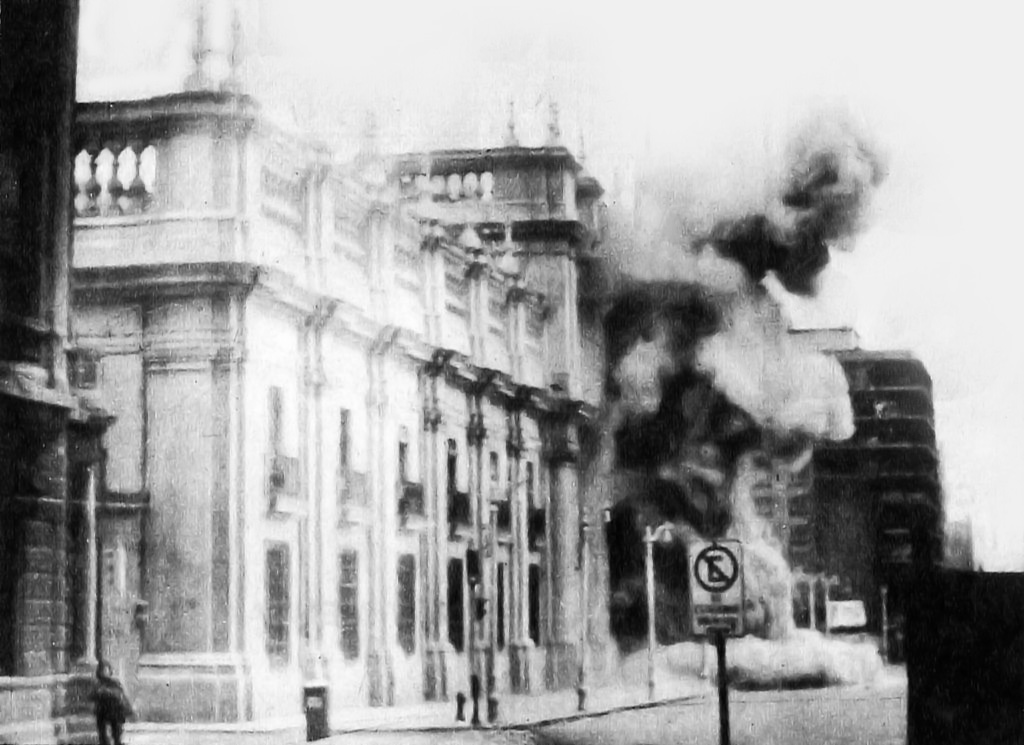
The bombing of La Moneda, 11 September 1973. Biblioteca del Congreso Nacional de Chile, CC BY 3.0 CL, via Wikimedia Commons.
To present it, press the full-screen button in its corner, then step through with the arrow keys or a clicker. Esc leaves.
Reuse and citation
Free to reuse under CC BY 4.0, with credit. Archival photographs are credited where they appear and keep their own terms.
Liam Wilkinson, “The Cybersyn operations room”, interactive, lwilko.com, 2026. https://www.lwilko.com/library/interactives/cybersyn-operations-room
A canvas model of the hexagonal operations room built for Project Cybersyn, designed by a team led by Gui Bonsiepe. The scenes cover the seven swivel chairs with armrest buttons, the wall screens and the slides behind them, the telex network linking factories to Santiago, and the Cyberfolk satisfaction meter. The two archival photographs shown in the explainer are third-party material and keep their own terms.
In the essays
- Neo-Technocracy: Same Dream, Bigger Budget
Read the essay
Sources
People
- Gui Bonsiepe
Depicts
- Salvador Allende
Depicts
- Stafford Beer
Depicts
Ideas
Cases
- Project Cybersyn
Depicts
Record history
Catalogue source: knowledge/interactives/cybersyn-operations-room.md
Generated by claude-code/claude-sonnet-5-5 on 2026-10-24