
Neo-Technocracy: Same Dream, Bigger Budget
Engineers have spent a century trying to run society like a machine. The machines were never the hard part.
In this essay
In the depths of the Depression, America went briefly mad for an idea. A group of engineers proposed to abolish money, measure the economy in units of energy, and pay everyone in certificates denominated in it. Their leader, Howard Scott, said the price system was about to collapse and that only engineers could run what came next. They called it Technocracy, and by the spring of 1933 it was a punchline.
I came across Scott the way I come across most things, down an internet rabbit hole. What kept me there was how familiar he sounded. Sam Altman thinks compute is "going to be the currency of the future", and has floated giving everyone on Earth a "compute budget", which is not far from an energy certificate. He expects the cost of intelligence to "converge to near the cost of electricity". When Nvidia agreed in 2025 to invest up to $100 billion in OpenAI, the money was to arrive "progressively as each gigawatt is deployed": investment, released in units of power. Data centres are sized in gigawatts now, not servers.
Technocracy has been tried in one form or another for a century, and its machines have rarely been the reason it failed. That isn't a case against technology (I'm an engineer, and I love the stuff), but it is a reason to look hard at the people and institutions around it. This essay traces the current mood back to its ancestors, and asks whether "technocracy" is even the right word for it. My suspicion is that each earlier attempt was missing something the present one has.
The Technate of America
Technocracy Inc. · New York · 1933
The Technate of America
1933
The Technocrats' Magazine promised "$20,000 a year income for every family", paid in energy rather than money.1940
Technocracy Inc. drew the Technate of America: one block from Greenland to Venezuela, borders erased. Howard Scott spoke of acquiring it "by purchase, negotiation, or the force of arms".1940s
Members wore grey and drove grey cars in long motorcades. A visitor to Vancouver in 1947 counted "150 cars in line all same color".
Technocrats with a sound car, late 1940s. Colour slide, photographer unknown, via the Technocracy Technate Picture Archive. Reproduced for criticism and review. The certificate
Income would come as energy certificates that "cannot be saved" and lose their validity at the end of each period. Nobody could hoard, because nothing kept.Continental Hydrology
The engineers would replumb the continent too: rivers joined by canals into one shipping network, "dams high enough to reverse the flow of rivers", and a lake in northern Ontario "as large as Lake Superior". Hydroelectric dams, Technocracy Inc. promised, caused "only minor ecological readjustments".Engineers, attention
An Engineering Corps would build it all, "unhampered by business or political interferences"; anyone who doubted it was "socially uninformed". Parts did get built. Quebec diverted whole rivers into its James Bay dams, but only after the Cree and Inuit took it to court and forced a settlement.
Technocracy grew out of a contradiction. By the early 1930s America could make almost anything. It had electrified its cities, built the assembly line and taken to heart Frederick Taylor's gospel that "in the past the man has been first; in the future the system must be first". Then, between 1929 and 1933, industrial production fell by more than half and a quarter of the workforce lost their jobs. The machines were still there. The plenty wasn't.
Engineers were the heroes of the age. The president who presided over the crash was a mining engineer. Roosevelt, dedicating the Hoover Dam in 1935, called it "an engineering victory of the first order". If engineers could tame the Colorado, why not the economy? Howard Scott had an answer: the trouble was money itself.
Scott is the best character in this story, and very little about him was true. He was tall (six foot five, by one account), wore a broad-brimmed hat, a leather coat and a red tie, and had spent a decade telling stories in Greenwich Village speakeasies: how he'd won a Notre Dame football game single-handed, how he'd shot a Mexican archbishop and galloped for the border. He was billed as "Dr. Scott" and let people believe he held a doctorate from Berlin. His engineering career had been a few months as foreman of a cement gang at Muscle Shoals. His actual business was floor polish.
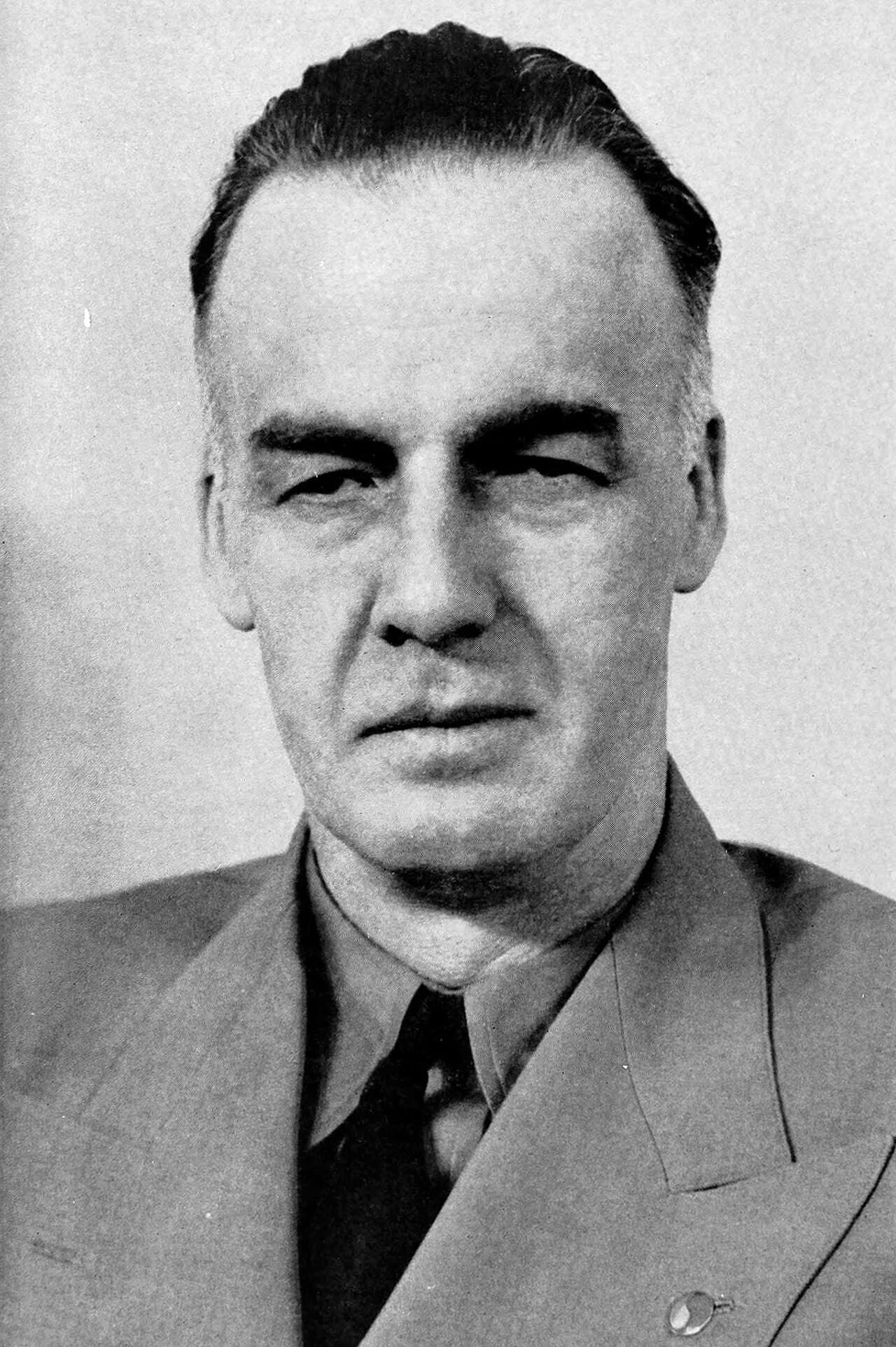
Howard Scott, "director-in-chief", in Technocracy Inc.'s own magazine, The Technocrat, November 1942. Photographer unknown. Public domain, via Wikimedia Commons.

Yet he kept remarkable company. His first circle, the Technical Alliance of 1919, included Thorstein Veblen, the economist who called for "a practical Soviet of technicians", and Charles Steinmetz, General Electric's four-foot-tall socialist wizard. In 1932 Walter Rautenstrauch, who ran Columbia's industrial engineering department, gave Scott a home for an "Energy Survey of North America", and a young geologist called M. King Hubbert signed up. Hubbert went on to predict, correctly, that American oil production would peak around 1970. Leon Henderson, another recruit, later ran Roosevelt's wartime price controls; a man from the movement to abolish prices ended up setting them.
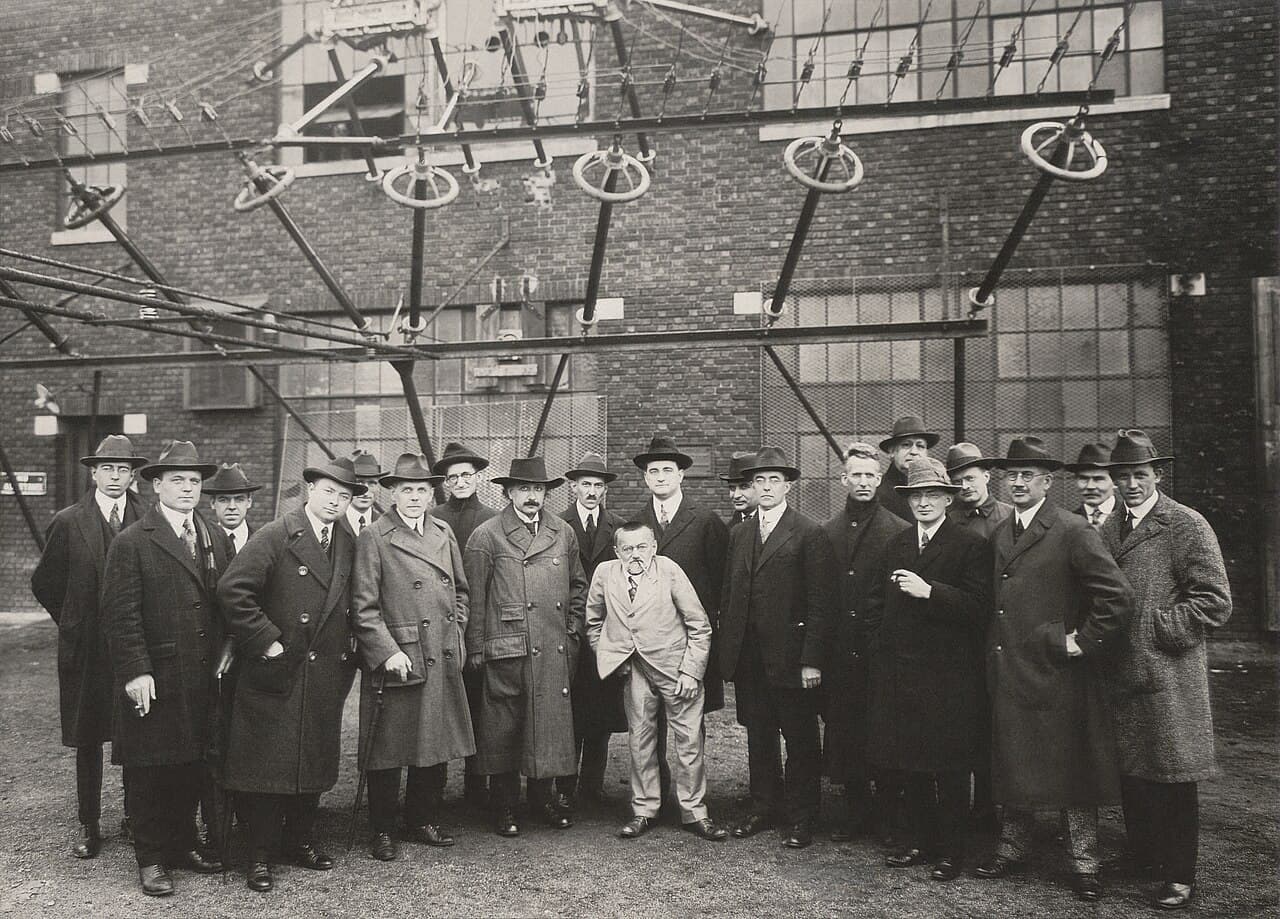
The company Scott's circle kept: Albert Einstein with engineers at an RCA radio station, 1921, among them Charles Steinmetz of the Technical Alliance. RCA / Hagley Museum and Library, public domain.
It came apart in weeks. In December 1932 Allen Raymond of the Herald Tribune went looking for Dr. Scott's doctorate and found the floor polish instead. In January Scott addressed the nation on the radio from the Hotel Pierre, promised "the most potent 14,000 words" ever written, and then refused to take questions. Ten days later Rautenstrauch, Henderson and two other Columbia engineers resigned, saying they were "not in accord with some of the statements and attitudes" of Scott, and Columbia showed him the door.
What survived was Technocracy Inc., incorporated that April with Scott as Director-in-Chief. It never came near power, and the way it ran itself explains why it never learned. It was a Technate in miniature, with posts filled by "appointment from above" and Scott in charge until he died in 1970, answering to a board whose members weren't told who sat on it. When 25 members asked in 1948 to elect that board, he expelled them by telegram. The collapse of the price system was postponed from 1940 to 1942 and then indefinitely, and the theory was never revised. Nobody inside was in a position to say it was wrong. That's the first of technocracy's peculiar ways of failing.
One of its Canadian leaders, Joshua Haldeman, was arrested in 1940, when Ottawa banned the movement. His grandson, Elon Musk, will come up again.
Soviet Cybernetics
Soviet philosophers had dismissed cybernetics in the early 1950s as a bourgeois pseudoscience. A decade later, in the thaw after Stalin, it was the science everyone wanted, and the planners wanted it most. Running a command economy means deciding, for every enterprise, what to make, from what and for whom, and every one of those decisions ripples through the others: change the steel target and you change the coal, the rail freight, the tractors and eventually the bread. The planners were balancing that web largely by hand, on desk calculators and abacuses. Viktor Glushkov, who ran the new Institute of Cybernetics in Kyiv, liked to warn that if nothing changed, nearly the entire adult population would be doing planning, accounting and management by the mid-1980s.
Glushkov · Kyiv · 1962
OGAS

1920
Lenin's formula, as Gustav Klutsis painted it in 1930: communism is Soviet power plus the electrification of the whole country. Power, measured in electricity.Gustav Klutsis, 1930. Plakatsammlung der Schule für Gestaltung Basel. Public domain. 1962
Forty years on, Viktor Glushkov proposes the next term in the equation: OGAS: a national computer network wiring every factory, mine and ministry to Moscow, to run the planned economy as it happened.The ministries
The ministries and the central statistics office had little wish to be read from the centre. The data stopped at their walls.1 October 1970
The Politburo declined to fund it. The plan drifted until Glushkov's death in 1982.
OGAS came closer than anything before it. It had a superpower behind it, some of the best computer scientists in the world, and an economy already run from the centre. But the ministries had every reason to keep their real numbers to themselves and none to send them to Moscow. The view from above only works if the parts agree to be seen, and nobody volunteers for that.
Chile's control room
Chile came at the same problem from the other end. Salvador Allende's government, elected in 1970, was taking copper mines, banks and hundreds of factories into state hands faster than it could find people to run them, while Richard Nixon told the CIA to "make the economy scream". Fernando Flores, a 28-year-old engineer at the state development agency, wrote to Stafford Beer, an English management cybernetician, for help. Beer's answer was not a Moscow-style plan. Each factory would run itself and report a handful of numbers every day; software would flag only the figures that drifted out of their usual range, and pass a problem upwards only if nobody below had dealt with it.
proyecto synco · santiago · 1972
sala de operaciones
Santiago, 1972
Stafford Beer and Allende's government built a room to steer a newly nationalised economy. Gui Bonsiepe's team designed it.Seven chairs
Fibreglass swivel chairs with buttons in the armrests to switch the screens. No keyboards: Beer didn't want to "insinuate a girl between themselves and the machinery".The screens
The walls showed the economy as flows, levels and alarms, in a visual language of their own.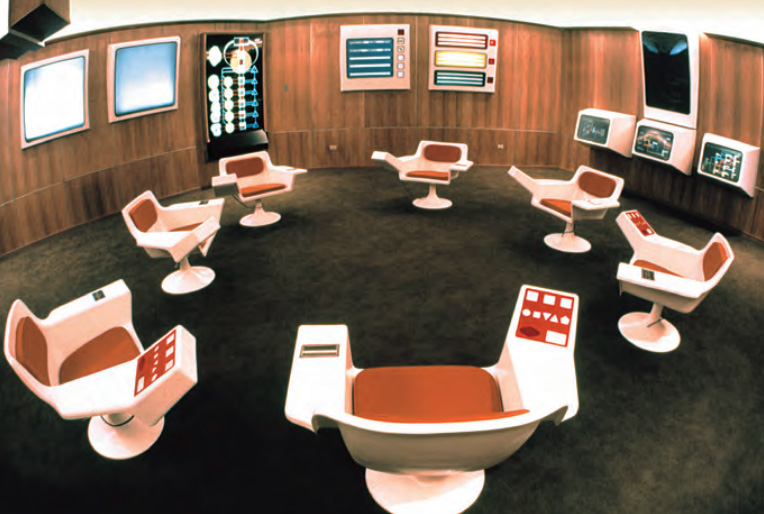
The operations room, Santiago, 1973. Photo: Rodrigo Walker, courtesy Gui Bonsiepe. Reproduced for criticism and review. Behind the screens
They showed prepared slides. The room looked more omniscient than its data ever was.Cybernet
The part that worked was humbler: a telex network linking factories to Santiago.Cyberfolk
A plan to let citizens signal their satisfaction as it happened. Beer's son built prototype meters from radio parts and pink and green cardboard. They never saw service.11 September 1973
The air force bombed the presidential palace. Allende died inside, and the project ended with him.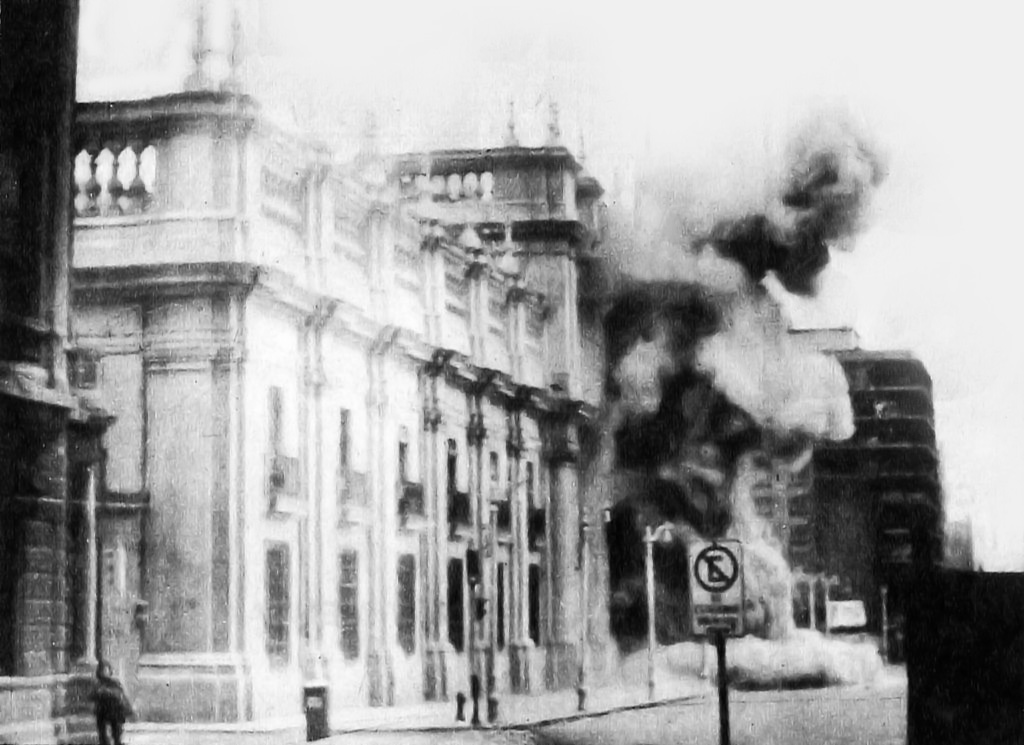
The bombing of La Moneda, 11 September 1973. Biblioteca del Congreso Nacional de Chile, CC BY 3.0 CL, via Wikimedia Commons.
Cybersyn had the will, a working network and one of the most beautiful rooms ever built for government. The coup ended it after two years, so nobody can honestly say whether it would have worked. What it does show is how persuasive a room can be. Beer spent his later years in a two-room cottage in mid-Wales, without running water.
What I saw at Number 10
I've seen a version of this work. During my time at Number 10, the data science team there, 10DS, ran dashboards drawing in data from across government, which became, in effect, the centre's view of much of it. I didn't build it. It grew out of the pandemic, after government found it couldn't say how many hospital beds it had while planning the next lockdown.
It began as a far smaller undertaking than anything above, closer to Beer's room than to Glushkov's network: show the centre of one government what its own departments were doing. Narrow in scope, but not in stakes, since the decisions it fed were the ones that reach a Prime Minister's desk. I suspect starting narrow is part of why it worked. It has since spread to almost every area of policy, and I'd count it among the crown jewels of British state capacity. The Innovation Fellowship it runs now numbers dozens of fellows, my fellow Fellows among them.
From the outside, it looks like what Glushkov wanted: a centre wired to every department. The difference is in how the wires got there.
10DS · Downing Street · since 2020
Number 10
2020
Born in the pandemic: a data science team inside Number 10, 10DS, set up after the centre found how little it could see.Departments
The data came from departments, one relationship at a time. Diplomacy first; special advisers when diplomacy wasn't enough.The front line
Behind the departments sit the services where the numbers start: hospitals, schools, police forces, jobcentres, courts and councils.rAPId
The plumbing is open source and deliberately simple. rAPId gives departments one consistent way to store and share named, standardised datasets.Today
On top sit the team's data science platform and the dashboards, read by Number 10 and the departments alike.
What made it work wasn't the software. The team spent much of its time on diplomacy, department by department, with special advisers to lean on people when persuasion wasn't enough. The dashboards were also only as good as the data scientists reading them: a chart shows what has happened, and the value lay in experts asking the hard question of what happens next. Nor was the view only from above. Departments saw the same dashboards, so everyone, the Delivery Unit included, worked from the same numbers. In cabinet government, where ministers answer to their constituents but also compete for one another's jobs, an agreed set of figures takes a whole category of argument off the table. Most departments came to see it as making their lives easier: one place to keep Number 10 up to date. That was the incentive the Soviet ministries never had.
Its power was borrowed, though. Liz Truss's reorganisation of Number 10 moved the data team and the Delivery Unit to make way for an economic unit, and we all saw how well that went for her. Rishi Sunak brought the team back shortly after taking office.
None of it happened overnight. For years, figures arrived as screenshots of tables pasted into emails, some of them from the Office for National Statistics; I saw plenty myself. And a dashboard is only as fresh as the statistics feeding it, which for most official series means monthly if you're lucky. OGAS and Cybersyn had the same problem.
The fastest numbers of the pandemic didn't come from government at all. To see whether the economy was moving again, the ONS turned to mobility data from BT, updated daily, because its surveys couldn't keep up. Official statistics lean more on proxies like these every year. The volume, velocity and variety that once made "big data" a buzzword now mostly belong to private companies.
Silicon Valley's machine
Scott had pencils, Glushkov had room-sized computers and ministries that wouldn't share, and Beer had a few hundred telex machines. A mid-range phone now outcomputes everything they had. The machinery stopped being the hard part some time ago; what matters now is who owns it.
Mostly, it isn't the state. The market built it first, for its own ends: advertising systems that know more about a population than any census, which Shoshana Zuboff called surveillance capitalism; commodity traders with an eye in the sky, reading a country's harvest from satellite images before its own agriculture ministry has counted it; supply chains tuned so finely that nobody notices them until one ship wedges itself across the Suez Canal; and the data centre build-out now holding up the economy. Investment in information processing equipment and software was about 4% of American GDP in the first half of 2025, yet by Jason Furman's rough reckoning it accounted for 92% of the growth.
Satellites and markets
The eye in the sky
Illustration. Traders buy satellite images of farmland to estimate a harvest before official forecasts, and count ships, cars and oil tanks from orbit; phone location data does the same for footfall. The ticker's figures are illustrative, not live prices.
The scale is hard to take in. Amazon, Alphabet, Microsoft and Meta expect to spend between $720 and $745 billion on capital investment this year, most of it on AI: more than China, Russia and Germany spent on their armed forces last year combined.
Bigger than armies
That is what makes this wave different. It needs no Prime Minister and no diplomacy, because the data already runs through its platforms; ownership does the work that political authority did at Number 10. San Francisco often sounds mad from outside, but it is the first technocratic culture with the capital, the incentives and the market structures to build what it talks about. The market pays for the building whether or not anyone believes the theory. For the first time, the theories get tested.
What I mean by neo-technocracy
This is where Joshua Haldeman's grandson comes back in. Last year the Harvard historian Jill Lepore traced a line from Technocracy Inc. to Elon Musk in the New York Times, observing that unlike the movement's founders, Musk "does have a theory for the assumption of power". Her story is about a technologist taking over the state. Mine is about something slightly different, the border between state and market dissolving from both sides, and I think it needs a name of its own.
I'm calling this neo-technocracy. The word has turned up before, loosely; I want to pin it to something specific, and narrower than "the tech elite has too much power". Companies now do what only states used to: they underwrite nuclear reactors, out-research national laboratories, put satellites over battlefields and build the data platforms governments run on. Microsoft's twenty-year power contract is bringing Three Mile Island back from retirement, and Alphabet alone spent about $61 billion on research and development last year, nearly three times what Washington gives all seventeen national laboratories. Governments have always bought their hard power from private firms, but they used to specify it, pay for it and own it. Now the companies decide what gets built, pay for it themselves and rent it back. When Ukraine asked for Starlink coverage near Crimea, the answer came from Elon Musk. States are crossing the line from the other side too, taking stakes in chipmakers and reactors.
It isn't a left or right project. Abundance liberals want a state that can build again. Techno-optimists want to drive energy and intelligence to infinity. Alex Karp and Peter Thiel want Silicon Valley's engineers working for a stronger, harder-edged West. They disagree about almost everything except the premise: that the bottleneck is engineering capacity, and that whoever can build should.
The backlash doesn't sort by party either. Bernie Sanders wants a national moratorium on new data centres. Ron DeSantis has signed a law letting Florida's towns turn them away, while Donald Trump warns that towns which do will end up "backwards and poor". Gallup found that 71% of Americans would oppose one in their area, more than would oppose a nuclear plant.
The data-centre horseshoe
Abundance, fiefs and exits
The biggest story is the one Howard Scott would recognise: abundance. Dario Amodei, who runs Anthropic, has suggested AI could compress fifty to a hundred years of biological progress into five or ten. Demis Hassabis of Google DeepMind says an end to disease may be "within reach", perhaps within a decade. Each of the big labs now has a body to study what follows. OpenAI's foundation has committed $25 billion to health and what it calls AI resilience; Anthropic has an institute for the challenges powerful AI will pose; DeepMind is hiring economists to study the future of scarcity.
It deserves to be taken seriously. Even a fraction of it would be the biggest change in living memory, and a world after cancer is worth wanting. Surveys of businesses still find little effect on jobs or productivity, but adoption figures have always lagged, and they miss what is new: models reaching the frontier in some of the hardest fields people have ever studied. DeepMind's AlphaGenome, which predicts how changes in DNA alter the way genes are switched on and off, looks nothing like a chatbot. "Post-scarcity" is still a slippery phrase, though. Land, energy, attention and status stay scarce however cheap intelligence becomes, and someone still decides who gets the compute.
The compounding staircase
Each step a research cycle: hypothesis, experiment, result, a better model for the next.
There are darker stories too. Critics like Yanis Varoufakis call it techno-feudalism: platforms that collect rents rather than compete for profits, with users for serfs.
Serfs were bound to the land. Some of the people building the platforms would rather not be bound to any state at all. In 2022 Balaji Srinivasan, once chief technology officer of Coinbase, described the network state: an online community aligned enough to act together, which "crowdfunds territory around the world" and eventually wins recognition from existing states. It is a country founded like a start-up, with citizens recruited before there is any land, and membership chosen rather than inherited. The nearest thing to a prototype is Próspera, a privately governed city on the Honduran island of Roatán, now suing Honduras for repealing the law that created it. Praxis, which calls itself a digital nation, has signed a largely non-binding deal to settle inside +Colonia, a planned city in Uruguay led by a former adviser to Argentina's president. Others have simply incorporated: Starbase, in Texas, is now a city run by SpaceX.
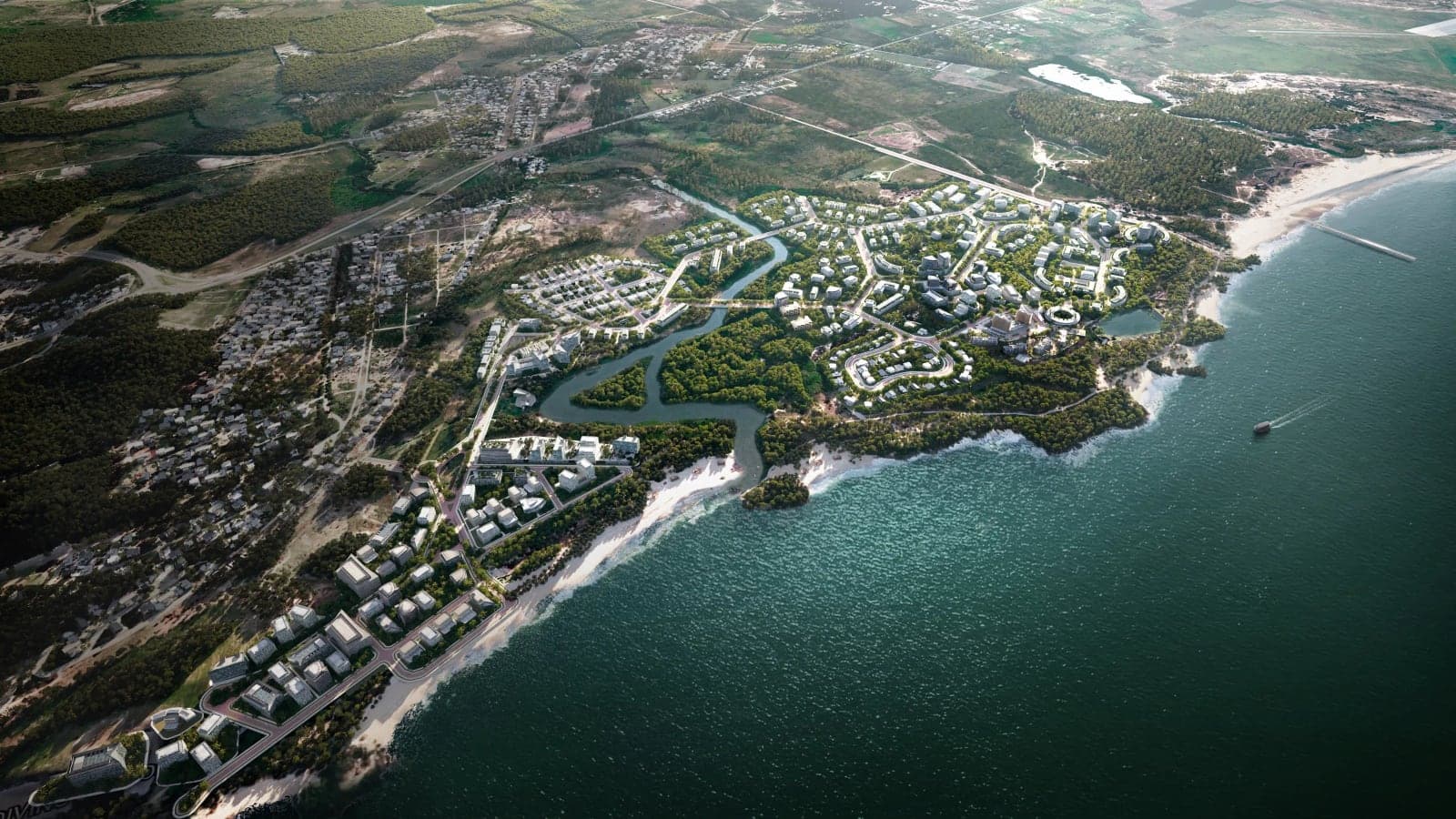
+Colonia, the planned city near Colonia del Sacramento, Uruguay, where Praxis has agreed to settle: the developer's rendering of the masterplan. © Ala Este SAS. Reproduced for criticism and review.
Every one of these futures needs someone to build the systems that run it. The earlier waves failed in three ways that keep coming back.
- Monoculture. You rise by sharing the beliefs of the people at the top, so the idea stops being questioned. Technocracy Inc. expelled the members who asked for a vote.
- A network state picks its own citizens, which makes it easy to fill with people who already agree.
- Turf. Each part of the system gains more by keeping its data than by sharing it, as OGAS's ministries did.
- Platforms guard their data and labs their models, so a government that depends on them may find the view from above split between companies that won't share it.
- Theatre. The display looks more certain than the data behind it, as Cybersyn's screens did.
- AI government risks the same, whoever builds it. DOGE "consistently overstated its savings in online posts", government auditors found.
Being told you're wrong
The Technocrats lacked power, the Soviets lacked incentives and Chile ran out of time. Neo-technocracy has power of a kind, in capital, and incentives to spare. What it runs into instead is the physical world. Intelligence may get cheaper every year, but the data centres need electricity, land, water and copper that everyone else wants too, and deciding who gets them is exactly the kind of trade-off politics exists to make.
None of the earlier failures was really about the machines. Technocracy Inc., run entirely by command from the top, had no way to hear that it was wrong. OGAS's ministries kept their real numbers to themselves, because in a system that punished missed targets, opacity was safer. Cybersyn's room made the numbers look surer than they were. Each is a way of losing the ability to be corrected. The version I saw at Number 10 got further because it sat inside a chain of accountability: when the numbers were wrong, a minister would be asked about it, and in the end so would voters.
The systems neo-technocracy is building sit mostly outside that chain. They answer to shareholders and customers (mostly…), which is a kind of accountability, just not one that reaches the people living next to the substation. So people are reaching for the levers they still have. Locally, that's planning permission. Nationally, it's this autumn's American midterms, where data centres have become a campaign issue in both parties. The industry has responded as industries do: Leading the Future, a super PAC network funded by AI investors and executives, has raised more than $100 million to back friendly candidates on both sides. If the backlash wins anyway, those trade-offs will be made by voters rather than investors.
None of this is an argument for building less. It's an argument that the institutions around the building matter more than the machines, and that ours will need to be a great deal more agile for what's coming. Not necessarily bigger, but quicker to learn, with their incentives engineered as carefully as any data centre, so that whoever holds the most powerful systems has good reason to listen when someone tells them they're wrong. That's engineering too, and it's the part technocrats have always skipped. Getting it right is what decides whether this is a future we all want to live in.
The Technate's circuit board again, this time without a border to stop at.
More where this came from.
New essays on AI, government and making things work. Sent when there’s something worth sharing.
Confirm by email. Unsubscribe whenever you like. Privacy
Sources & notes
Explore the works and ideas behind this essay. Each catalogue record shows whether its description has been checked.
View all sources and notes for this essayJoin the conversation
Comments use GitHub. You can read them without signing in.
All views expressed here are my own.